Osaka Takoyaki Tour: History, Best Spots, and How to Eat It Right
Takoyaki is Osaka's most iconic dish and the starting point for almost every osaka street food tour. A spherical dumpling of dashi-flavoured batter, octopus, pickled ginger, and green onion, cooked in a cast-iron mould until crispy outside and running liquid inside — it was invented in Osaka in 1935 and has been replicated in every prefecture in Japan without once being surpassed. This guide covers the history, the craft, the best places to eat it in Osaka, and how to tell the good versions from the ones made for tourists.
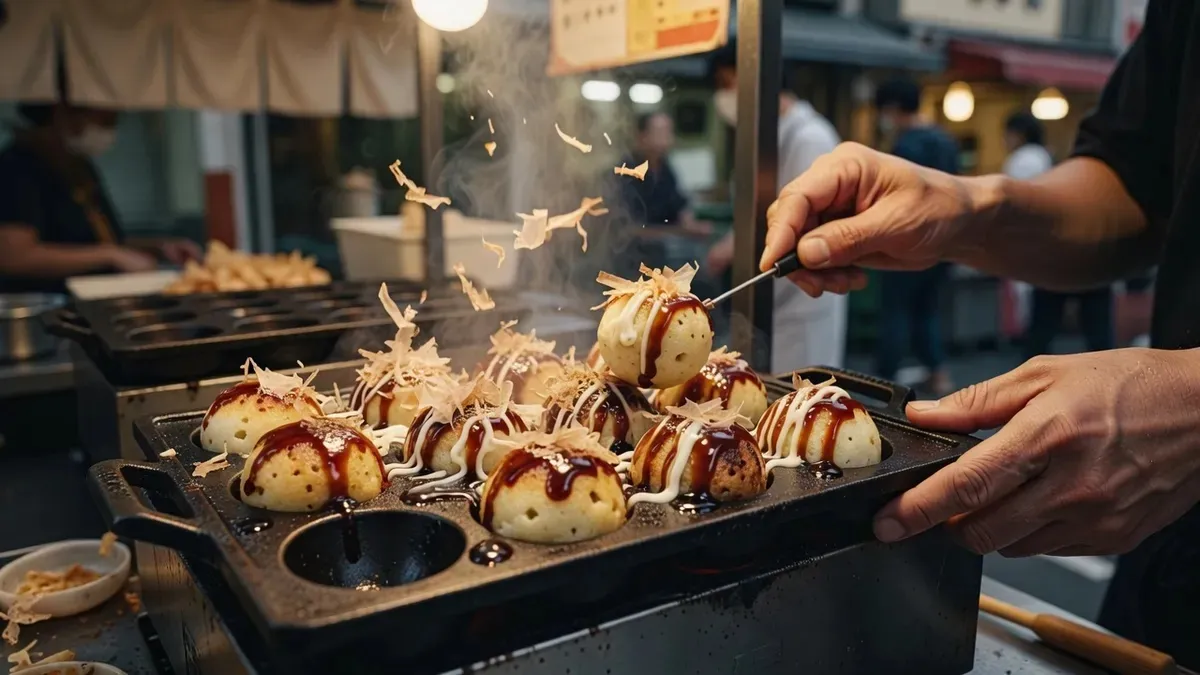
Takoyaki: What It Is, Where It Came From, How to Eat It
The Origin of Takoyaki in Osaka (1935)
Takoyaki was invented by Tomekichi Endo at his Aizuya restaurant in the Namba district of Osaka in 1935. Endo adapted an earlier dish — akashiyaki (a softer egg-heavy dumpling from Akashi city, eaten in a dashi broth) — by creating a panko-free batter using dashi stock and eggs, adding octopus as the filling, and cooking in a cast-iron mould with hemispherical cavities.
The key technical contribution was the turning method: using a metal pick, the half-cooked ball is rotated 180 degrees while still molten inside, allowing the exterior to set while the interior remains liquid. This is now a trained skill — street stall cooks with decades of practice can turn a tray of 16 takoyaki simultaneously with a single fluid movement. The result: a sphere that is crispy and slightly charred outside, and almost soup-like inside.
Within 30 years of its invention, takoyaki stalls had spread across all of Japan's major cities. Osaka claims, correctly, that none of the imitations match the original — primarily because osaka dashi stock uses a specific ratio of kombu and katsuobushi that defines the characteristic flavour.
- Invented: 1935, Namba district of Osaka, by Tomekichi Endo at Aizuya restaurant
- Base batter: dashi stock (kombu + katsuobushi), eggs, wheat flour
- Filling: octopus cube, pickled ginger (beni shoga), green onion (negi), tempura scraps (tenkasu)
- Toppings: takoyaki sauce (similar to Worcestershire), Japanese mayo, bonito flakes, dried seaweed
- The mould: cast-iron, 16 cavities — temperature and turning timing define quality
How to Tell Good Takoyaki from Mediocre Takoyaki
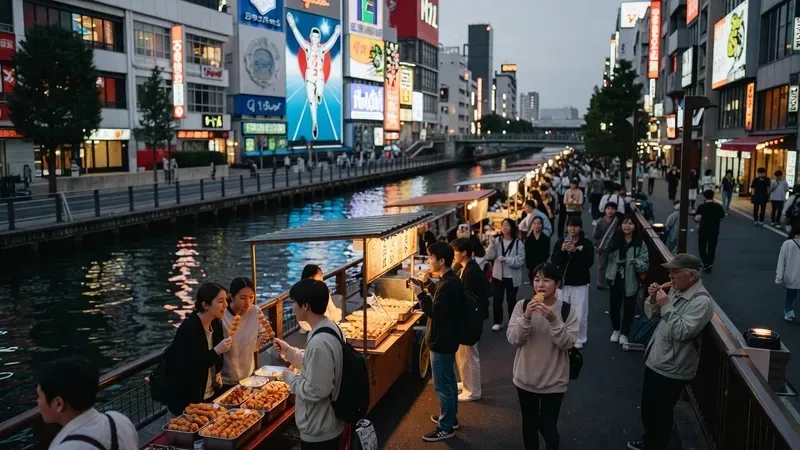
The tourist-facing takoyaki stalls on Dotonbori promenade sell an acceptable version. The difference between acceptable and excellent is defined by three factors: dashi quality, interior texture, and octopus size.
A good takoyaki has an interior that is almost liquid — if you bite through and nothing flows, it's been overcooked. The dashi should be intensely savoury with a clean finish, not floury or bland. The octopus piece should be a cube of 1.5–2 cm, tender rather than rubbery, with a slightly chewy edge. Mediocre takoyaki has a uniform semi-solid interior, weak dashi flavour, and a small rubbery octopus that shows up only if you excavate.
| Feature | Good Takoyaki | Tourist-Grade Takoyaki |
|---|---|---|
| Interior texture | Near-liquid, flowing when bitten | Uniform semi-solid throughout |
| Dashi flavour | Strong, complex, clean finish | Mild or floury background flavour |
| Octopus | 1.5–2 cm cube, tender, present in every ball | Small, rubbery, sometimes absent |
| Crust | Lightly charred, thin, audible crunch | Thick, pale, or soggy |
| Temperature | Dangerously hot interior (let it rest) | Warm throughout, safe immediately |
| Cooking time | Made to order, served immediately | Pre-cooked batches held warm |
| Stall type | Neighbourhood stall or market vendor | Tourist-facing promenade stand |
Takoyaki Variations Across Osaka
Osaka's competitive stall culture has produced several regional variations on the standard takoyaki format. Most are available on the main food streets; a few appear only at specific stalls or markets.
- Standard (Osaka-style): dashi batter, octopus, ginger, green onion, tenkasu — the original
- Akashiyaki: softer, egg-heavier batter, served in dashi broth for dipping rather than with sauce
- Cheese takoyaki: melted cheese added to the interior — popular with younger osaka residents
- Mentaiko takoyaki: spicy cod roe instead of or alongside octopus
- Takosen: a single takoyaki pressed inside a crispy senbei rice cracker — dotonbori speciality
- Vegan-adjacent: some stalls substitute konbu-only dashi and mushroom filling (very rare)
Best Takoyaki Spots in Osaka and Tours That Include Them
Where to Find the Best Takoyaki on a Self-Guided Visit
The most honest answer about where to find the best takoyaki in Osaka: the neighbourhood stalls that don't appear on any tourist list are usually better than the famous ones. That said, several well-known spots consistently produce excellent quality and are worth knowing.
Daiki Suisan in Kuromon Market, Wanaka in Namba, and the unnamed vendor at the south end of Hozenji Yokocho are regularly cited by osaka residents as genuine standouts. Kukuru in Dotonbori has a long queue but delivers a legitimately good product. The Ichiba street stalls near Tsuruhashi (osaka's Koreatown) produce a less famous but frequently excellent version.
- Wanaka (Namba): consistently rated among osaka's best by local food media
- Kuromon Market vendors: market-grade ingredients, lower tourist markup
- Hozenji Yokocho stalls: street atmosphere plus good quality in a compact space
- Kukuru (Dotonbori): famous, queue-worthy, genuinely good — best avoided 12–3 PM
- Neighbourhood stalls in Shinsekai: lowest prices, quality varies, can be excellent
- Tsuruhashi area: off the tourist circuit, local prices, reliable quality
Which Osaka Street Food Tour Has the Most Takoyaki?
Every guided osaka street food tour includes at least one takoyaki stop. The tours that offer the most context — history, craft explanation, stall selection — are the 3-hour Shinsekai tours, where the guide can explain the dish's Osaka origin story while choosing a specific stall over the tourist alternatives.
The award-winning Hungry Osaka street food tour (15 tastings, Shinsekai) includes a dedicated takoyaki stop as part of the 15-tasting sequence, alongside a guide explanation of the dashi quality and turning technique. The 17-food Shinsekai street food tour covers similar ground with a focus on variety across different stall types.
For a takoyaki-specific experience, the Dotonbori walking tour (2 hours, $50) often starts with takoyaki or takosen as the first food stop, on the promenade where the dish has its tourist heartland.
- Most takoyaki tastings: award-winning Hungry Osaka street food tour (15 total tastings, Shinsekai) — see the <a href='/blog/osaka-night-food-tour/'>full night tour guide</a>
- Best takoyaki-first experience: Dotonbori and Namba street food walking tour ($50) — see the <a href='/blog/osaka-street-food-walking-tour-dotonbori/'>full walking tour guide</a>
- Most varied: Goen Japan street food tour (17 tastings, 3 hours)
- Stall selection: all guided tours choose non-tourist stalls by preference
Osaka Takoyaki Tour — FAQ
What is in takoyaki?
Takoyaki is made from a dashi-flavoured batter of wheat flour, dashi stock, and eggs, with a filling of octopus (tako), pickled red ginger (beni shoga), green onion (negi), and tempura scraps (tenkasu). Toppings applied after cooking: takoyaki sauce (similar to Worcestershire), Japanese mayonnaise, dried bonito flakes (katsuobushi), and dried seaweed (aonori).
Why is osaka takoyaki better than takoyaki from other cities?
Osaka's takoyaki advantage is primarily dashi quality and technique. Osaka water is soft (low mineral content), which produces a cleaner, more nuanced dashi broth — the same reason Osaka and Kyoto cooking are considered the best in Japan for light, clear-broth dishes. The technique — interior temperature, turning timing, mould temperature — is also more refined in osaka's competitive stall culture than in cities where takoyaki is a secondary product.
Is takoyaki safe if you're allergic to shellfish?
No — takoyaki contains octopus, a cephalopod mollusc. While it's technically not a crustacean (shrimp, crab, lobster), guests with shellfish or mollusc allergies should avoid it. The dashi broth also typically contains katsuobushi (dried fish), making it unsuitable for fish allergies as well.
Can I make takoyaki at home?
Takoyaki requires a specific cast-iron or electric mould — it cannot be replicated in a standard pan. The moulds are widely available in Japanese kitchen shops and on Amazon. A home takoyaki kit typically includes the mould and a recipe card. The most important variable is the dashi quality — using instant dashi powder produces a noticeably inferior result compared to hand-drawn kombu and katsuobushi dashi.
How hot is takoyaki when it's served?
Dangerously hot — the interior reaches very high temperatures because the liquid batter acts as a heat trap. A freshly served takoyaki should rest for 2–3 minutes before biting into it. The standard beginner mistake is biting immediately and burning the roof of the mouth on the molten interior. Osaka locals eat it with the turning pick, splitting it open slightly first to release the steam.
What osaka street food tour is best for takoyaki enthusiasts?
The award-winning Hungry Osaka night street food tour in Shinsekai includes a dedicated takoyaki stop with guide explanation of stall selection and preparation technique — full guide at our <a href='/blog/osaka-night-food-tour/'>osaka night food tour page</a>. The Dotonbori and Namba street food walking tour starts on the promenade where takoyaki was made famous and typically opens with it — full guide at our <a href='/blog/osaka-street-food-walking-tour-dotonbori/'>dotonbori walking tour page</a>.