Osaka Night Food Tour: Hungry Osaka's Award-Winning Shinsekai Experience
The Hungry Osaka Street Food Tour is the best osaka night food tour for one specific reason: it doesn't go where tourists go. Three hours through Shinsekai — osaka's retro 1920s neighbourhood — visiting five local spots your guide has eaten at hundreds of times: a kushikatsu counter, a yakitori grill, a standing bar, a takoyaki stall, and an oden-and-udon final stop. Fifteen tastings. Three drinks. Eight people maximum. 4.9 stars from 1,569 reviews.
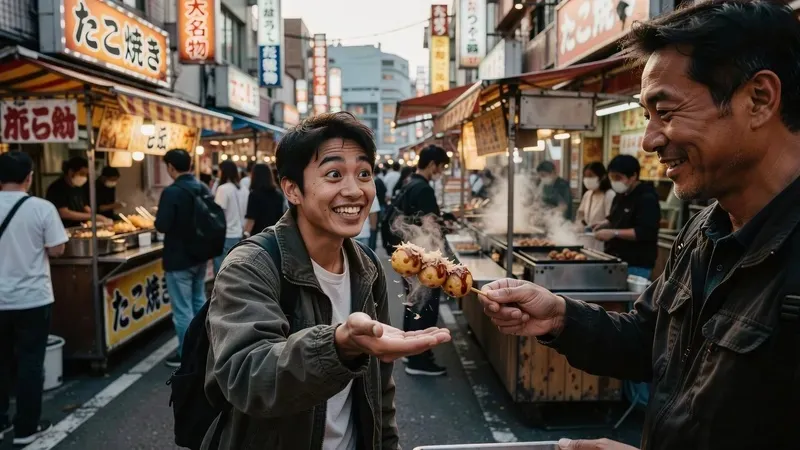
About This Tour
Up to 24 hours before — full refund
Book your spot today, pay later
Evening departures — check availability for times
At 5 local Shinsekai eateries
Intimate size for tiny venues
97% of English speakers give it a perfect score
Check Tonight's Availability
The Hungry Osaka tour runs every evening. With a cap of 8 guests, weekend spots fill fast — check availability now and book with free cancellation.
What Happens on the Osaka Night Food Tour
Meeting at Ebisucho Station — The Gateway to Shinsekai
The osaka night food tour meets at Ebisucho Station Exit 3 on the Metro Sakaisuji Line — 15 minutes before the listed start time. From central Osaka (Namba, Shinsaibashi), it's a 7-minute direct ride. Your guide will be at the top of the stairs at Exit 3, easy to spot in a relatively quiet station.
Shinsekai starts directly above. The name means 'New World' — it was built in 1912 to imitate Paris (the southern half of the neighbourhood) and New York's Coney Island (the northern half). Both models aged out of fashion by the 1970s, leaving behind a neighbourhood of elderly residents, discount izakayas, and the kushikatsu counters that became Shinsekai's entire identity. In the last decade it's become a destination — but the food is still the real thing.
- Meeting point: Ebisucho Station, Metro Sakaisuji Line, top of stairs at Exit 3
- Arrive 15 minutes before your tour time
- Nearest hotels: Namba / Shinsaibashi area — 7 min by metro (Sakaisuji Line, direct)
- No large bags — venues are tiny, leave luggage at your hotel
Stop 1 — Kushikatsu and Doteyaki: Shinsekai's Signature Start
The tour opens at a kushikatsu counter — the dish that defines Shinsekai and, by extension, osaka's street food identity. Skewers of meat, vegetables, and seafood are battered in a light panko coating and deep-fried to order, served with a communal dipping sauce. The rule — never double-dip — is enforced at every Shinsekai counter without exception. Your guide explains it before you're seated, usually with the kind of mild theatrical emphasis that makes it clear they have seen visitors break it.
Alongside the kushikatsu comes doteyaki: beef tendon simmered for hours in sweet white miso until it dissolves into something closer to a savoury paste than a stew. It arrives next to a roasted garlic clove and a small cup of the miso broth. This is not export Japanese food — it is the specific flavour of a cold evening in Shinsekai, eating at the same counter as the same regulars who have eaten here since the 1980s.
- Kushikatsu: battered deep-fried skewers — the Shinsekai speciality since the 1920s
- Doteyaki: miso-simmered beef tendon, rich and sweet, served with roasted garlic
- The double-dip rule: one dip per skewer into the shared sauce — never twice
- Drinks: first of the 3 included drinks is served here
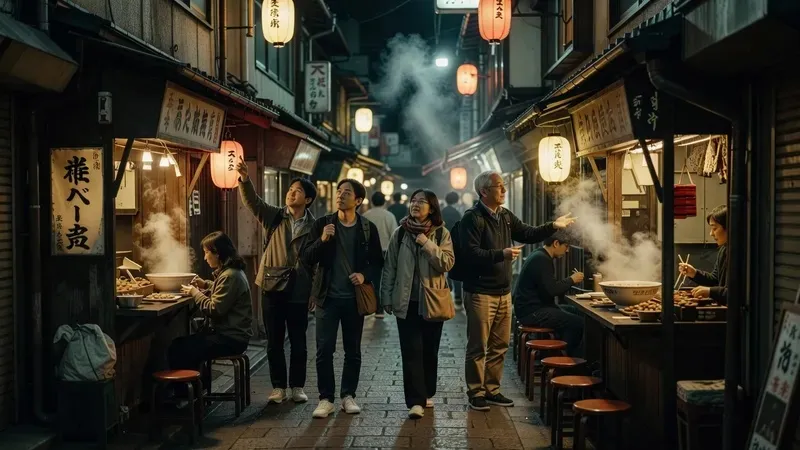
Stops 2 & 3 — Karaage, Takoyaki, and Yakitori
The tour moves through Shinsekai's backstreets to a karaage specialist: osaka's version of japanese fried chicken, marinated in ginger and soy, significantly lighter and crispier than western equivalents. From there, a takoyaki stall — the cast-iron mould, the octopus, the sauce choices, and the moment of gooey interior that makes it either a revelation or a test of trust depending on your expectations.
Stop three is a yakitori restaurant: charcoal-grilled skewers of chicken, pork, and vegetables, served with a cold drink at a low wooden counter. Your guide knows the menu entirely and will order around your preferences — the marinated chicken thigh and the asparagus with bacon are the unanimous recommendations from seven years of guides.
Stops 4 & 5 — Standing Bar, Oden, Udon, and Dessert
Stop four is a tachinomiya — a japanese standing bar. This format is central to osaka's after-work culture: no seats, low prices, cold drinks, and snacks ordered in rounds. It exists because osaka office workers have been using it as a decompression chamber between work and home for over a century. Your guide orders the local sake or beer, and the bar snacks arrive with them.
The final stop is oden and udon: a hot pot of simmered fish cakes, daikon, and vegetables in a dashi seaweed broth, alongside udon noodles served osaka-style in a golden, lightly sweet broth. This is comfort food in its most literal form. The tour ends with a dessert — often fried ice cream or a seasonal japanese sweet — and the third included drink. From Dobutsuen-mae Station, you're three stops from Namba.
- Stop 4: tachinomiya (standing bar) — sake or beer with izakaya snacks
- Stop 5: oden (simmered hot pot) and osaka-style udon in dashi broth
- Dessert: fried ice cream or seasonal sweet
- Third drink: alcoholic or non-alcoholic — your choice
- End point: near Dobutsuen-mae Station (3 stops from Namba)
What's Included, What to Know, and Who This Is For
Everything Included in the Hungry Osaka Tour Price
- 15 tastings at 5 local Shinsekai eateries: kushikatsu counter, karaage stall, takoyaki stall, yakitori restaurant, and a standing bar/oden stop
- 3 drinks — alcoholic (local sake, beer) or non-alcoholic at every stop
- Your experienced guide for the full 3 hours
- Insights into Shinsekai's history, architecture, and food culture as you walk
Important Things to Know Before You Book
Hungry Osaka runs a professional food operation with clear guidelines. Reading these before you book avoids surprises.
- Video and audio recording of the tour is not permitted — photography of food and sights is fine
- If you have specific dietary needs, contact the operator after booking — they cannot cater for gluten-free, vegan, or strict vegetarian diets as the entire menu contains wheat, fish stock, or meat
- Very occasionally an eatery may be full or temporarily closed — the guide always has a backup stop
- The tour runs in all weather — Shinsekai's lanes are partially covered
- Gratuity for your guide is not included in the price and is appreciated
Who This Osaka Night Food Tour Is For
The Hungry Osaka tour is the right pick for any adult or older child (10+) who wants to eat real Osaka food rather than restaurant-row approximations. It is not a cocktail crawl or a highlights tour with a snack attached — it is three hours of genuinely excellent osaka food in the neighbourhood where that food was invented.
- Suitable for: adults, older children (10+), first-time Japan visitors, food-focused travellers
- Not suitable for: children under 10 years
- Not suitable for: vegetarians — every dish contains meat, seafood, or fish-based broth
- Not suitable for: vegans or guests with gluten intolerance for the same reasons
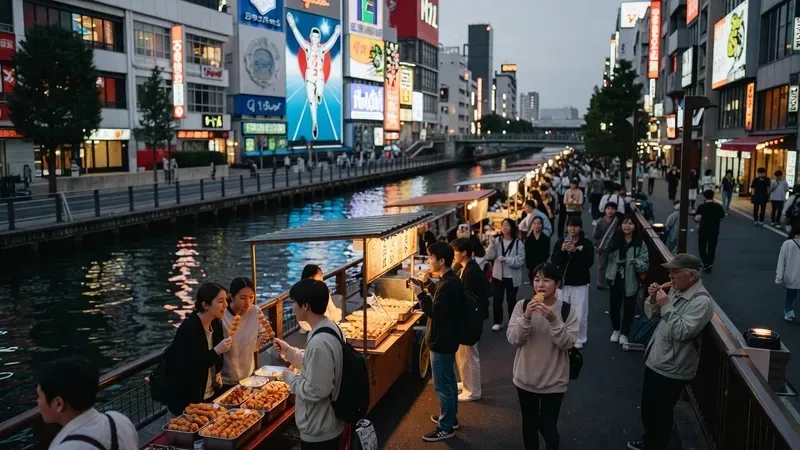
Where the Osaka Night Food Tour Meets: Ebisucho Station
Guides, Reviews & What Travellers Say
Who Are the Hungry Osaka Tour Guides?
Hungry Osaka Tours employs a rotating team of experienced english-speaking guides — Andy, Scott, Tim, Anna, Adam, Kenzo, and Davin have all been named individually in verified reviews. Several have lived in osaka for a decade or more. They are not reading from a script: they know the chefs personally, understand the history of the dishes they're serving, and have strong opinions about which stop at which time of year is at its best.
With a maximum group size of 8, these are not guides managing a crowd — they're running a private dinner party for people they just met. The tour consistently scores 5.0 on guide quality across all review platforms.
Hungry Osaka Night Food Tour — FAQ
How is the Hungry Osaka tour different from other osaka night food tours?
The Hungry Osaka tour is limited to 8 guests — smaller than most osaka food tours (which run to 9–12). It operates exclusively in Shinsekai rather than tourist-dense Dotonbori, meaning every stop is a genuine local eatery that has been there for decades. The 15 tastings across 5 stops is also more food than most tours: guests consistently report leaving too full to eat again.
What time does the osaka night food tour start?
Departure times vary by date — check availability on the booking page for exact start times. Most evening slots run from around 6 PM. The tour ends approximately 3 hours after the listed start, near Dobutsuen-mae Station which connects directly to Namba via the Midosuji Line.
How many people are on this night food tour?
The Hungry Osaka tour is capped at 8 guests per departure. This small group size is intentional — the eateries on the route have limited counter space, and the guide's ability to give individual attention changes entirely above a certain group size. Several competing tours run to 12–15 guests; the difference in experience is significant.
What does the award-winning mean?
Hungry Osaka Tours has received multiple external recognitions for the quality of their food tour, including mentions in travel publications and high-ranked placement on major booking platforms. More practically, a 4.9-star average from 1,569 verified bookings — with 97% of English-speaking guests giving a perfect score — is the most meaningful measure.
Is 15 tastings really that much food?
Yes — guests consistently describe leaving the tour too full for dinner. The 15 tastings across 5 stops are not tasting-spoon portions; they are full servings at each stop, scaled to a group of 8. Come having eaten lightly earlier in the day. The guideline from the operator: don't eat for 4 hours before the tour.
What happens if it rains?
The tour runs rain or shine. Much of the Shinsekai route passes through covered arcades and partially covered lanes, and the eateries themselves are fully indoors. A light rain jacket is sensible for the walk between stops.
Are drinks alcoholic? Can I choose non-alcoholic?
Both options are available at every stop. The 3 included drinks can be alcoholic (local sake, osaka beer, highball) or non-alcoholic (soft drinks, iced barley tea) — your guide will ask your preference at each stop. There is no obligation to drink alcohol.
Kenzo took us to a standing bar so small there were six stools and they were all regulars except us. We ate three rounds of kushikatsu without speaking a word of Japanese because he handled everything. A masterclass in how a city actually feeds itself.
Anna knew every dish's history — by the end of the night we understood not just what we were eating but why Osaka developed these specific flavours. The rice merchant culture, the market tradition, the obsession with freshness. I've been on food tours in 12 countries and this is the most substance I've encountered.
We arrived in Osaka that afternoon. By the end of the night tour with Davin we felt like we lived here. Fifteen dishes is exactly as much as it sounds, and somehow the last oden stop was still the best thing I ate.