Osaka Food Tour: Kuromon Market — Japan's Kitchen in One Covered Arcade
Kuromon Ichiba Market is a 580-metre covered shopping street in the Nipponbashi district — established in 1902 and still operating on the same principle: fresh seafood, meat, and produce from osaka's most concentrated professional food market, sold directly to the public at the stall that prepared it. This osaka food tour guide covers what to eat, when to go, how to navigate it, and which guided tours visit it as part of a longer street food route.
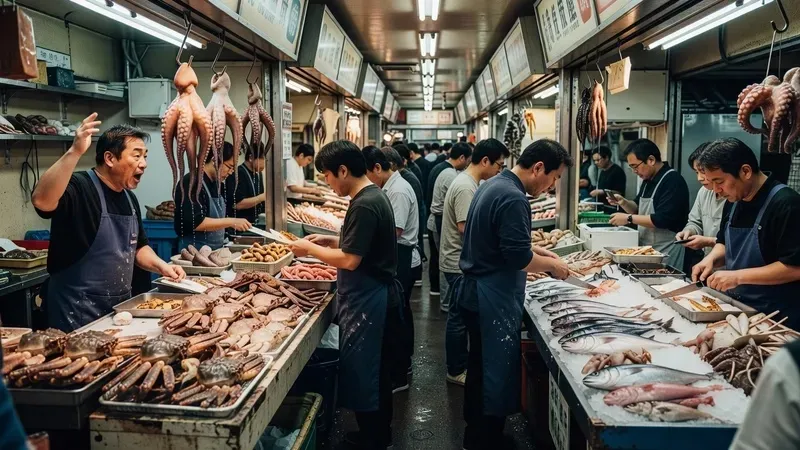
What to Eat at Kuromon Market on an Osaka Food Tour
Kuromon Market's Essential Food Stops
Kuromon Ichiba Market has around 180 stalls operating under a single covered arcade approximately 580 metres long. Most are wholesale and retail food vendors — the interesting stops for an osaka food tour are the ones that cook or prepare food on-site, allowing you to eat at the stall immediately.
The market specialises in fresh seafood from Osaka Bay and the broader Kansai region. Tuna is the centrepiece: several stalls offer tuna sashimi, tuna sushi, and tuna skewers prepared to order. The quality is consistently excellent because the market's customer base — Osaka restaurant chefs — demands it. Retail quality is what professional kitchens won't buy, which in Kuromon means it's better than almost any fishmonger you've encountered outside of Japan.
| Stall Type | What to Order | Price Range | Best Time to Visit |
|---|---|---|---|
| Tuna / seafood stalls | Tuna sashimi, grilled seafood skewers | ¥500–¥1,500 | Morning (9–11 AM) |
| Oyster stalls | Fresh oysters, grilled oysters | ¥200–¥600 each | Autumn–Spring |
| Fugu (puffer fish) stalls | Fugu sashimi, fugu karaage | ¥800–¥2,000 | Oct–Mar (season) |
| Tamagoyaki stalls | Dashi-infused rolled omelette | ¥300–¥500 | Morning and midday |
| Produce vendors | Seasonal fruit, pickled vegetables | ¥200–¥800 | Morning |
| Prepared food stalls | Tempura, sushi, street snacks | ¥400–¥1,200 | 11 AM–2 PM |
| Matcha / dessert shops | Matcha ice cream, mochi, taiyaki | ¥200–¥500 | All day |
What Makes Kuromon Different from Dotonbori
The comparison comes up constantly in osaka street food guides: Dotonbori vs Kuromon. They are adjacent districts (10 minutes on foot) but operate on entirely different logic.
Dotonbori is the entertainment and food district — restaurants, bars, and famous stalls producing food for tourists and diners. Kuromon is a professional market that happens to sell to the public. The difference shows up in every category: the price per unit is lower, the product turnover is faster, the staff are producing food as a trade rather than an experience, and the variety skews toward raw, fresh ingredients alongside prepared foods.
For an osaka food tour, Kuromon works best as a morning stop (9 AM–12 PM) before the afternoon crowds arrive, and before eating at sit-down restaurants elsewhere.
- 580-metre covered arcade: start at the Nipponbashi end and walk west toward Namba
- Best for raw seafood, grilled items, professional-grade fresh produce
- Morning (9–12 PM): quieter, freshest stock, best tuna quality
- Afternoon (12–3 PM): busier, some stalls running low on premium cuts
- Avoid: Sunday afternoons — tourist crowds at their densest
Kuromon Market Opening Hours, Getting There & Touring Tips
Kuromon Market Hours, Location & Access
Kuromon Ichiba Market (officially Kuromon Ichiba Hanbai Kyodo Kumiai) is located in Chuo-ku, Osaka, between Nipponbashi Station (Sennichimae Line) and Namba Station. The market runs roughly east-west along Kuromon Ichiba Shotengai.
Most stalls are open 9 AM to 6 PM, with some opening as early as 7 AM (wholesale hours). By 4 PM, the premium items are often sold out. The market is closed on Wednesdays for most individual stalls, though some remain open.
- Address: Kuromon Ichiba Shotengai, Nipponbashi 2-chome, Chuo-ku, Osaka
- Hours: most stalls 9 AM–6 PM; best selection before 1 PM
- Closed: most stalls close Wednesdays; check individual vendors
- Nearest station: Nipponbashi Station (Sennichimae Line, Exit 5 — direct entry) or Namba Station (10 min walk)
Kuromon Market as Part of a Wider Osaka Street Food Tour
Kuromon works well as a standalone 90-minute visit, but its real value shows up when it forms part of a wider osaka street food tour — using the market for fresh food and raw ingredients as context before hitting the cooked-food districts of Dotonbori, Shinsekai, and Ura Namba later in the day.
The wheelchair-accessible Local Guide Stars walking tour (the guided Osaka food tour on this site) is specifically suited for guests who want a more leisurely osaka food experience — it covers similar ground across multiple districts with specific accommodation for mobility needs.
- Combined with Dotonbori: 10-minute walk west from the market
- Combined with Shinsekai: 15-minute walk south or Sennichimae Line (one stop)
- Combined with Namba: 10-minute walk through the covered arcade
- Guided food tours that cover Kuromon area: see <a href='/blog/osaka-street-food-walking-tour-dotonbori/'>Dotonbori walking tour</a>
Self-Guided Kuromon Market Food Tour: A Suggested Route
Starting at the Nipponbashi east entrance, walk slowly west. At the first seafood cluster (first 100 metres), stop for tuna sashimi or grilled oysters. Continue past the produce section — note the seasonal items — and stop at a tamagoyaki (rolled omelette) vendor around the 250-metre mark for a warm skewer.
At the market's halfway point, most of the prepared-food stalls cluster: tempura, grilled seafood skewers, crab legs. End at a matcha or dessert shop near the Namba west entrance.
- Entry: Nipponbashi end (east) — easier parking, less initial tourist crowd
- First 100m: seafood stalls — tuna sashimi, oysters, ikayaki (grilled squid)
- 250m mark: tamagoyaki and produce stalls
- 300–450m: prepared food concentration — tempura, sushi, grilled skewers
- West end: matcha dessert shops and final snacks before Namba
- Allow 60–90 minutes to eat properly without rushing
Kuromon Market Osaka Food Tour — FAQ
Is Kuromon Market worth visiting on an osaka food tour?
Yes — for anyone interested in professional-grade seafood and produce at market prices, Kuromon is one of the best 90-minute food experiences in Osaka. It is more interesting than Dotonbori for food quality, and more accessible than Tsukiji Market in Tokyo for self-guided touring. The caveat: arrive before noon for the best selection.
Can you eat at Kuromon Market without speaking Japanese?
Yes, with some limitations. The market sees enough tourist traffic that several stalls have point-and-order menus in English or with photos. Raw seafood stalls are the easiest — you point, they prepare. Specialty items (fugu, sea urchin, crab) may require a guide or a translation app for the full ordering experience.
What is Kuromon Market's most famous food?
Fresh tuna is the signature — several stalls cut tuna to order and serve it as sashimi or nigiri, and the quality is genuinely exceptional given the professional wholesale buyer base. Grilled oysters and fresh sea urchin (uni) are the next most popular among visitors.
Is there a guided osaka food tour that specifically visits Kuromon Market?
The wheelchair-accessible Local Guide Stars osaka street food walking tour (available on this site) visits the Kuromon and Nipponbashi area as part of a multi-district route. See the <a href='/blog/osaka-street-food-walking-tour-dotonbori/'>full guide to walking tours</a> for a comparison of all six available osaka food tours.
How long does it take to walk through Kuromon Market?
The market is approximately 580 metres long — a straight-through walk takes about 10 minutes. Stopping to eat at stalls, browse produce, and queue at the popular seafood vendors typically extends a visit to 60–90 minutes. An early morning visit (9–10 AM) with time to eat at three or four stalls requires about 90 minutes.
What's the difference between Kuromon Market and Dotonbori?
Kuromon is a professional food market that sells to the public — it prioritises quality and freshness for chef buyers. Dotonbori is an entertainment and dining district built for tourists and restaurant-goers. Both are worth visiting; Kuromon is better for fresh raw ingredients and morning food, Dotonbori is better for cooked street food in the evening.