Best Street Food in Osaka Japan: The Complete District Guide
Osaka earns its reputation as Japan's kitchen city — 'kuidaore' (eat until you drop) is the local motto, and the street food that fills every covered arcade, canal promenade, and backstreet izakaya is its proof. This guide covers the best street food in osaka japan: the essential dishes, the districts where you'll find them, the prices to expect, and when a local guide makes the difference between finding the real thing and eating the tourist version.
The Essential Osaka Street Food Dishes
Takoyaki, Kushikatsu, Okonomiyaki: Osaka's Culinary Highlights
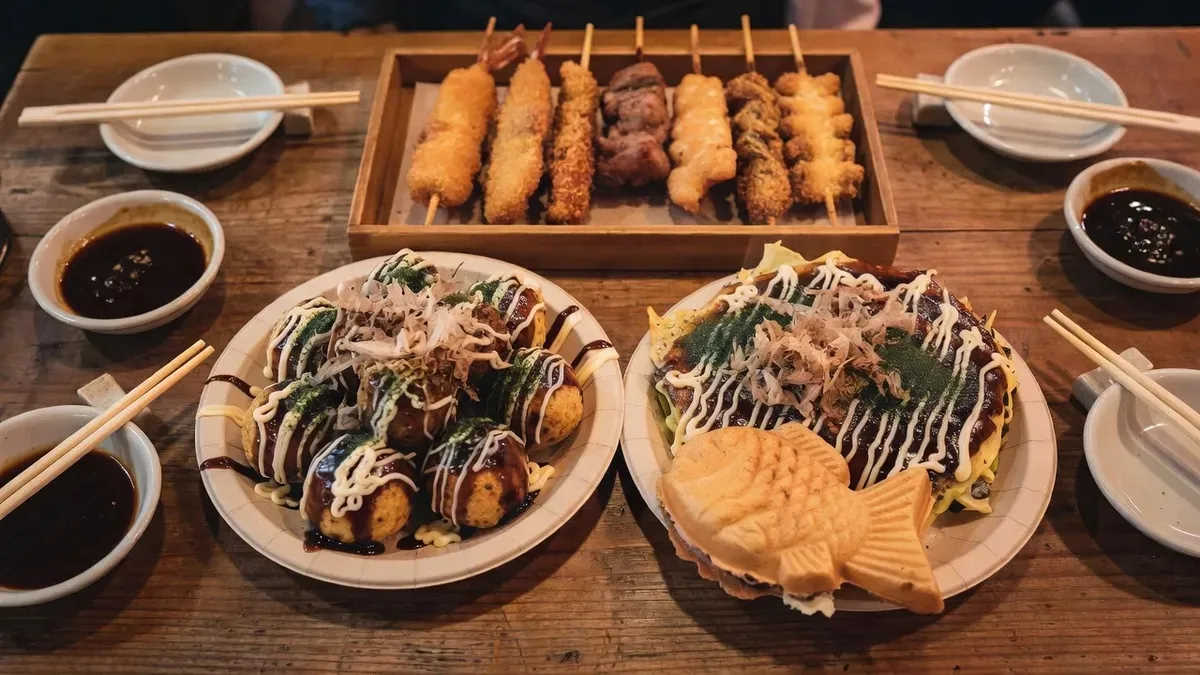
Three dishes define the best street food in osaka japan — they appear on the menu at virtually every street stall, covered market, and izakaya in the city, and each has a specific origin story tied to Osaka rather than to Japanese cuisine in general.
Takoyaki was invented in 1935 by Tomekichi Endo in the Namba district: a cast-iron mould with hemispherical cavities, each filled with a batter of dashi stock, green onion, ginger, and a cube of octopus, sealed into a ball and turned with a pick. The exterior is slightly crispy; the interior should be almost liquid. Yoshida Sauce, bonito flakes, and dried seaweed go on top. The variation across different stalls — dashi concentration, ball size, sauce sweetness — is enough to constitute a minor obsession among osaka locals.
Kushikatsu comes from Shinsekai: meat, vegetables, and seafood on bamboo skewers, battered in panko breadcrumbs and deep-fried. The communal dipping sauce at every Shinsekai counter is the defining feature — and the strict no-double-dip rule (enforced by a sign at every table) is the first thing any guide will explain.
Okonomiyaki is Osaka's savoury pancake: a batter of flour, dashi, and eggs, mixed with shredded cabbage, meat or seafood, and cooked on a teppan griddle. 'Okonomi' means 'what you like' — the toppings are variable. The osaka style (Kansai-style) mixes everything into the batter before cooking; the Hiroshima version layers ingredients separately. Osaka people have opinions about this distinction.
| Dish | Origin District | Price Range | Best Areas to Find |
|---|---|---|---|
| Takoyaki (octopus balls) | Namba (1935) | ¥300–¥600 / 6 pcs | Dotonbori, Namba, Shinsekai |
| Kushikatsu (fried skewers) | Shinsekai (1920s) | ¥100–¥250 per skewer | Shinsekai, Dotonbori |
| Okonomiyaki (savoury pancake) | Osaka, WWII era | ¥700–¥1,200 | Namba, Shinsaibashi |
| Ikayaki (grilled squid) | Osaka fish market | ¥400–¥700 | Kuromon Market, Dotonbori |
| Taiyaki (fish-shaped sweet) | Osaka (Meiji period) | ¥200–¥350 | Namba, Shinsaibashi arcade |
| Doteyaki (miso beef tendon) | Shinsekai | ¥500–¥800 | Shinsekai only |
| Takosen (octopus cracker) | Dotonbori | ¥100–¥300 | Dotonbori canal promenade |
| Udon (osaka-style) | Kansai region | ¥500–¥900 | Everywhere, best at local shops |
Which Osaka Street Food to Try First (and in What Order)
The sequence matters — not because of digestion, but because the flavour profile of osaka street food builds from light to rich. Start with takoyaki (clean dashi flavour, light texture), move to something fried (kushikatsu or karaage), then the heavier dishes like okonomiyaki or doteyaki. Save sweet taiyaki for the end.
This is also roughly the geographical sequence of a Dotonbori → Hozenji → Namba → Shinsekai walk.
- Round 1: Takoyaki from a Dotonbori canal stall — 6 pieces, eat immediately
- Round 2: Kushikatsu or karaage at a Shinsekai counter (no double-dip)
- Round 3: Okonomiyaki cooked on a teppan griddle at a seated table
- Round 4: Doteyaki (miso beef tendon) if you're in Shinsekai
- Round 5: Taiyaki (red bean fish waffle) or matcha dessert to finish
Osaka Street Food Districts: Where to Go and When
Dotonbori: The Iconic District (With Caveats)
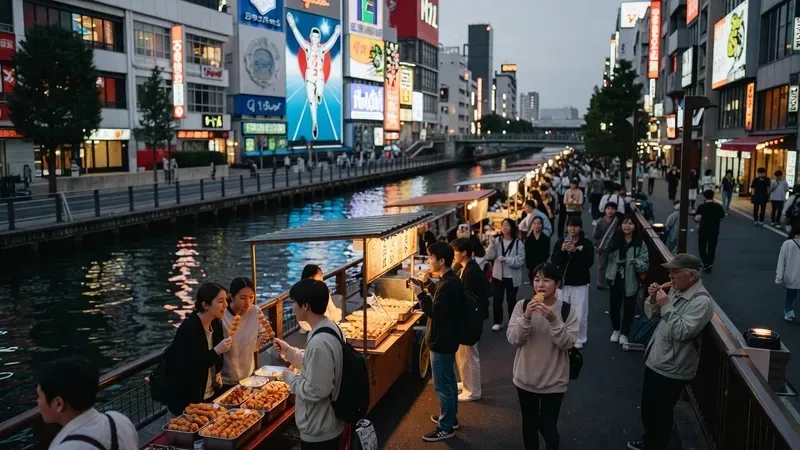
Dotonbori is where almost every visitor to Osaka begins — the canal promenade, the Glico Man sign, and the mechanical Kani Doraku crab. The street food here is genuinely good, but the prices are tourist-adjusted and the queues at famous stalls (particularly Ichiran ramen and Kukuru takoyaki) are long. The best strategy: use Dotonbori as your starting point and orientation, eat one or two dishes here, then walk 10 minutes in any direction.
The southern promenade has the best stall-style street food: takoyaki, takosen, and roasted sweet potatoes. The perpendicular alleys running north from the canal into Namba have cheaper, better izakaya. The Shinsaibashi shopping arcade north of Dotonbori has taiyaki and other sweets at lower tourist-tax prices.
- Best for: takoyaki, takosen, Glico Man photos, first-hour orientation
- Avoid: the longest queues at Ichiran and Kukuru — alternatives are just as good
- Best time: evenings after 6 PM for neon atmosphere; daytime for shorter queues
- What locals eat here: almost nothing — they know where to go instead
Shinsekai: Where the Best Street Food in Osaka Japan Actually Lives
Shinsekai ('New World') was built in 1912 to imitate Paris and Coney Island simultaneously. Both references faded by the 1970s, leaving a neighbourhood of elderly residents, discount arcades, and the kushikatsu counters that became its entire identity. In the last decade it has become a destination, but the food remains the real thing.
The district is a 15-minute walk or 10-minute metro ride from Dotonbori (Sakaisuji Line to Ebisucho). Every other shopfront is a kushikatsu counter. Doteyaki — miso-simmered beef tendon — is the other Shinsekai signature, served at the same counters. The area also has the best value okonomiyaki in central Osaka.
- Best for: kushikatsu (the best in the city), doteyaki, local atmosphere
- Prices: significantly lower than Dotonbori for the same or better quality
- Getting there: Sakaisuji Line to Ebisucho — 7 minutes from Namba Station
- Best time: evenings (6–9 PM) when the retro neon signs are lit
Namba and Ura Namba: Hidden Backstreet Osaka Food
Namba Station is the transport hub that connects Dotonbori, Shinsekai, and Shinsaibashi. The main shopping area (Namba Parks, Takashimaya) has little of interest for street food. The value is in Ura Namba — 'behind Namba' — the grid of narrow streets east of the station where the izakaya, tachinomiya (standing bars), and ramen shops operate for a local office-worker crowd.
These venues have handwritten menus in Japanese and no English signage. This is both the attraction and the barrier — without a local guide, finding them is difficult; with one, they become the highlight of any osaka street food tour.
Guided Tour vs Self-Guided: Which Makes Sense for Osaka's Street Food?
The honest answer: it depends on your appetite for navigation and language difficulty. Most of Dotonbori and Namba can be navigated in English — the tourist infrastructure handles it. Shinsekai and Ura Namba cannot: menus are in Japanese, staff often speak none or very little English, and the best stalls are in alleys with no signage at all.
If your Osaka visit is primarily a city-hopping stopover (1–2 days), a guided osaka street food tour is more efficient than independent research. If you're spending a week, start with a guided tour and use it to build an independent map for the rest of your trip.
| Factor | Guided Tour | Self-Guided |
|---|---|---|
| District access | Shinsekai, Ura Namba, hidden backstreets | Dotonbori, Namba main streets easily |
| Language barrier | Guide handles all ordering | Japanese menus in most real spots |
| Discovery speed | 5+ spots in 2–3 hours | 2–3 spots in the same time |
| Crowd avoidance | Guide knows timing and alternatives | Queues at tourist stalls likely |
| Cost | $50–$81 per person (all food included) | Variable — ¥1,500–¥3,000 self-led |
| Flexibility | Fixed route, some guide discretion | Full control of timing and dishes |
Best Street Food in Osaka Japan — FAQ
What is the most famous street food in Osaka?
Takoyaki is the single most associated dish with Osaka — it was invented here in 1935 and has been the city's signature street food ever since. Kushikatsu (deep-fried skewers from Shinsekai) and okonomiyaki (savoury pancake) follow closely. If you're visiting Osaka and eat only three things, those are the three.
How much does osaka street food cost?
Prices vary sharply between tourist-facing stalls and local spots. Takoyaki runs ¥300–¥600 for six pieces; kushikatsu is ¥100–¥250 per skewer; okonomiyaki ¥700–¥1,200 for a full plate. Budget ¥2,000–¥3,500 for an independent two-hour eating session, or $50–$81 for a guided tour with all food included.
When is the best time to eat street food in Osaka?
Evenings (6–10 PM) are the prime time for osaka street food culture — the neon lights, the after-work izakaya crowd, and the full range of stalls are all operational. Daytime (11 AM–3 PM) works well for Kuromon Market and Dotonbori. Shinsekai is quiet before 5 PM and at its best from 7–9 PM.
Where is the best takoyaki in Osaka?
Osaka locals will argue about this at length. The most commonly cited by guides and food writers: Wanaka (Namba), Takoyaki Juhachiban (Dotonbori), and the unnamed stalls in Kuromon Market. On a guided osaka street food tour, your guide will take you to whichever stall they personally recommend — which is almost always different from the tourist-facing famous names.
Can vegetarians eat osaka street food?
With difficulty, but not impossibly. The default in osaka street food is meat, seafood, or fish-based dashi broth in almost everything. Vegetarian-accessible options include: taiyaki (fish-shaped waffle with red bean filling — no actual fish), some okonomiyaki variations without meat, and matcha sweets. Strict vegans will find osaka street food very limited without significant pre-planning. See our <a href='/blog/osaka-street-food-walking-tour-dotonbori/'>Dotonbori walking tour</a> for vegetarian-friendly guided options.
What is the best osaka street food tour?
The best osaka street food tour depends on your priority. For maximum food quantity: the <a href='/blog/osaka-night-food-tour/'>Hungry Osaka night tour</a> (15 tastings, Shinsekai). For the most accessible first tour: the <a href='/blog/osaka-street-food-walking-tour-dotonbori/'>Dotonbori walking tour</a> ($50, 2 hours). For the most off-the-beaten-path experience: the <a href='/blog/osaka-izakaya-bar-hopping-tour/'>Ura Namba izakaya bar hopping tour</a> (5 stops, hidden backstreets).
What does 'kuidaore' mean?
'Kuidaore' (食い倒れ) is an Osaka phrase meaning 'eat until you drop' or 'ruin yourself with eating.' It's the local counterpoint to Kyoto's 'kimodaore' (ruin yourself with clothing) — a playful claim that Osaka people spend their money on food rather than fashion. It appears on tourist signs throughout Dotonbori but it reflects something genuine: food is taken extremely seriously in osaka, and the street food culture is the most visible expression of it.